We are celebrating this evening Rama Navami, the appearance day of Lord Ramacandra. Many of you know quite well the history of Rama. Very briefly, for those who may not be so familiar, we are celebrating the appearance in this universe of a very important incarnation of God, the Supreme Lord who came to the world as Rama, or Ramacandra, in the celebrated Raghu dynasty a long, long time ago, before recorded history in the Western sense of the term.
Just as nowadays there are many bad leaders in the world, so also long, long ago there was a demon, or asura, named Ravana. The very name Ravana means that he made the whole world cry in anguish. Ravana had received a blessing from Brahma, the engineer or secondary creator of the universe, that he could not be killed by any god. Ravana did not ask for immunity from death at the hands of human beings, because he had contempt for human beings.
To understand this story, which traditionally has been understood as history, not as mythology, we have to also understand the picture of life that we receive in the ancient Vedic literature, which has come down to us from India. We find a much more cosmopolitan, sophisticated picture of the universe, not the provincial view we find in modern materialistic society that we human beings are all in all. Modern scientists often ridicule former ways of thinking by saying that people believed the earth was the center of the universe and that all the planets went around the earth. Scientists laugh at this geocentric model. But they themselves have not improved upon this, because they are very much geocentric and anthropocentric, in the sense that, as far as they know, in the universe there is nothing but them; there is no life in other places. Sometimes they speculate that they may be discovering other planets, but as far as they know there is nothing else. They tend to ridicule the information we receive in ancient literature that the universe is filled with intelligent living beings.
Not Mythology
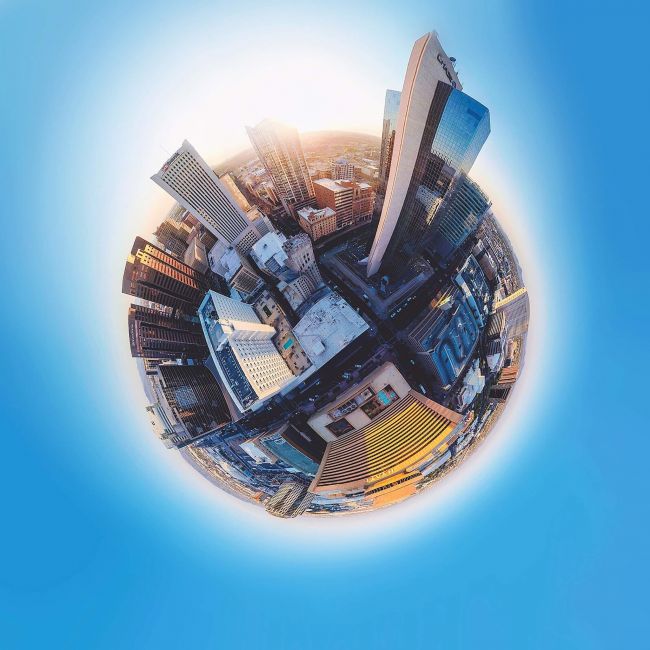
It should not be taken as mythology when we hear that long, long ago Ravana received a benediction from Brahma that he would not meet death at the hands of the superior living beings who manage the universe. For example, an intelligent human being can understand that in this city, Phoenix, there are trained people managing. It’s not automatically that the lights go on, that the traffic lights work, that there’s electricity, that when you turn the switch on your tap, water comes out, that food is being delivered to the wholesale and retail markets in an orderly fashion, and so on.
These things are not going on automatically. But from the point of view of a child or an animal these things are automatic. Similarly, this modern notion that all these forces within the universe the cosmic lighting, the cosmic water supply, the wind, and so on are working automatically is not an advanced or scientific notion; rather, it’s the view of a child or an animal.
So we can see practically that people have now become like animals. That is stated in Vedic literature:
ahara-nidra-bhaya-maithunam ca
samanyam etat pasubhir naranam
dharmo hi tesam adhiko viseso
dharmena hinah pasubhih samanah
The first premise here is that there is no difference between human beings and animals in the basic functions of eating, sleeping, mating, and defending. We eat, the animals eat; we sleep, they sleep; and so on. But dharmo hi tesam adhiko visesah: the particular superiority of human life lies in dharma. A human being has the capacity to ascertain and to willfully, consciously obey the laws of God. That capacity is normally absent in lower forms of life. And so a human being who is bereft of dharma who in no way understands that there are laws of God and higher spiritual principles is equal to an animal.
This is very simple logic. If you say in abstract terms that a is distinguished from b by a certain quality you can call y, then if you remove y there’s no further distinction. Then a equals b. So because people nowadays have no sense of dharma, they are equal to animals.
The only dharma nowadays is that I have my rights. There’s no further talk of dharma. The discourse is in terms of rights. I have a right to do anything, whatever I want to do to enjoy my body. My body belongs to me. I can kill my baby if I like. I can kill animals if I like. I can do anything. Because people have become like animals, because they have no dharma, they cannot understand the intelligence behind the natural arrangements.
So there are devatas, or gods, intelligent living beings who manage the universe, and long, long ago Brahma gave the benediction to Ravana that he could not be killed by the devatas. Ravana, being contemptuous of human beings, didn’t ask for protection from humans. The devatas prayed to the Supreme Lord, “Please come to this world playing the role of a human being, because that is a loophole in Ravana’s contract. Ravana can be killed by a human being.”
The devatas wanted to maintain law and order without breaking Brahma’s contract with Ravana. If you own a company and sign a contract with someone, even though the contract may not be favorable or may cause some harm, you want some solution that does not explicitly violate the terms of the contract, because law and order has to be maintained. So the request of the devatas is significant in that way.
It is also significant that God the Supreme Lord, Purusottama, Bhagavan can come down to this world. After all, if you are the owner, if you create some enterprise and it is under your administration then no one can stop you if you want to go to your warehouse, your factory, your office, your clinic, or whatever. Who can stop you? So if Krsna, or God, wants to come to this world, Krsna can come.
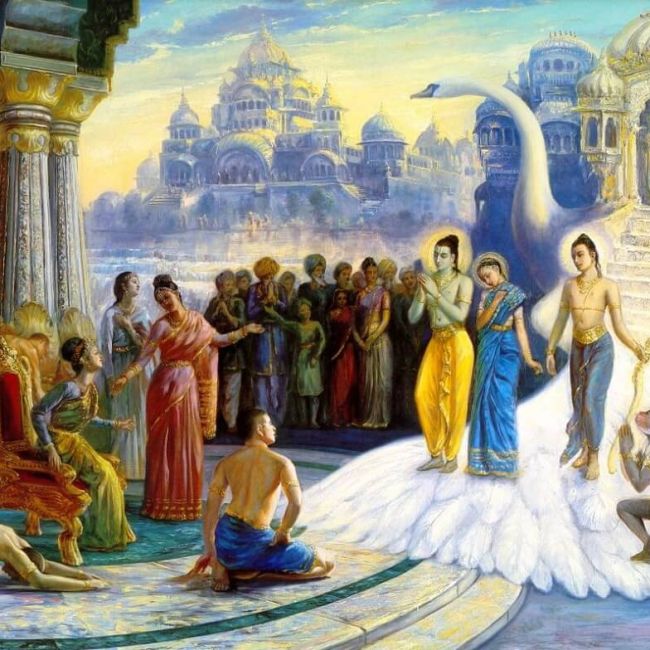
Now, as many of you know, God came and appeared as the perfect king, Rama, and there are so many stories told in the history known as the Ramayana. Somehow Ravana, this evil person, kidnapped the wife of Rama, the famous Sita, the ideal woman. She is called jagad mata, “the mother of the universe.” On the pretext of rescuing Sita, Rama killed Ravana and saved the world.
If you study the character of Ravana, you find that in many ways he was a very advanced, educated person. And his kingdom, Sri Lanka, was very sophisticated. Even Hanuman, the great devotee of Rama, was impressed by the cultural level of Lanka. There were all kinds of performing arts and culture and poetry, and very beautiful people. Everything was organized very nicely. The economy was flourishing. There was exquisite architecture. Practically in every sense it would have to be considered an ideal place to live.
There was only one flaw in Ravana’s program, as Srila Prabhupada repeatedly points out. The one mistake, the one fatal flaw in Ravana’s program of social development, was that he wanted to enjoy Laksmi (Sita) without Narayana (Rama). Laksmi is the goddess of fortune, and her husband is Narayana, the Supreme Lord.
When Krsna was here five thousand years ago, He lived in Dvaraka, in Gujarat. So that place was also flourishing. The difference between Sri Lanka and Dvaraka, or between Sri Lanka and Ayodhya, the kingdom of Rama, was that in Dvaraka and Ayodhya people were accepting Laksmi with Narayana, whereas Ravana thought, “I will take Narayana’s place. I will take Laksmi without Narayana.” And therefore despite all his qualifications, he was destroyed.
Modern Ravanas
It is plain to see that modern society tends more to the Ravana side, to take Laksmi without Narayana. That is called secularism, and it is causing modern problems. Everyone knows how the world is becoming poisoned. From the environmental perspective, the world is being poisoned because people’s minds are poisoned by this evil thought that “I can take Laksmi.”
The notion that “I can take Laksmi without Narayana” is wrong. If we understand anything from the Ramayana, from the glorious story of Rama, we should understand this point. We should not try to take Laksmi in any way, shape, or form, without Narayana.
We should rather be like the Ayodhya-vasis, the residents of Ayodhya. They had not become like Ravana. They knew Lord Rama as the proprietor of everything. From the Vedic point of view, the very first principle you find is that God is the supreme proprietor. The isopanisad, among all the Upanisads, has a special place historically because it is the only Upanisad directly taken from the text of a Vedic samhita, or treatise the Sama Veda. In the isopanisad the very first statement is isavasyam idam sarvam: “Whatever exists in the universe is the property of God.”
And Lord Krsna says in Bhagavad-gita, sarva-loka mahesvaram: “I am the proprietor, the great Lord of all the worlds.” He also says, aham sarvasya prabhavo mattah sarvam pravartate: “I am the source of everything; everything emanates from Me.”
Every word in the Gita is significant. Krsna says, iti matva bhajante mam: “Intelligent persons worship Me.” This is the real point of the Ramayana. We should clearly understand the fault of Ravana. He did not recognize the position of Rama or Narayana.
Becoming Ayodhya-vasis
Let us take advantage of this occasion to remember Rama and to rededicate ourselves to the real work of human life. If you study Ayodhya, you find that the residents were not impoverished. It was the most opulent city. It is not that by considering oneself a humble servant of Rama one becomes a loser. We can identify in some way with the residents of Ayodhya. We can see what their attitude was, how they were living. People talk about Rama-rajya, the reign of Rama. Of course, this is a controversial topic in India nowadays. But at least if we want Rama-rajya, we should begin with ourselves. We should ask ourselves, “How am I prepared to become an Ayodhya-vasi?” It’s not simply a question of getting other people to do things; am I prepared to become like the residents of Ayodhya? Am I prepared to act as a loving servant of Rama the way those people did?
The real way to have Rama-rajya is to convince others to love Rama and to act in this mood, as loving servants of God. The residents of Ayodhya were prepared to do anything for Rama. When He was exiled to the forest, they were all prepared to go with Him. He had to convince them to stay behind, to keep His city going. It’s not that they were prepared to worship Rama only if they would get some opulence. They were prepared to give up everything in a moment to be with Rama or to satisfy Rama. They could do anything for the satisfaction of Sita and Rama. So when a significant portion of the people have this understanding, then automatically, naturally, there will be Rama-rajya.
(From a lecture given in Phoenix, Arizona, USA, on 4.16.97)